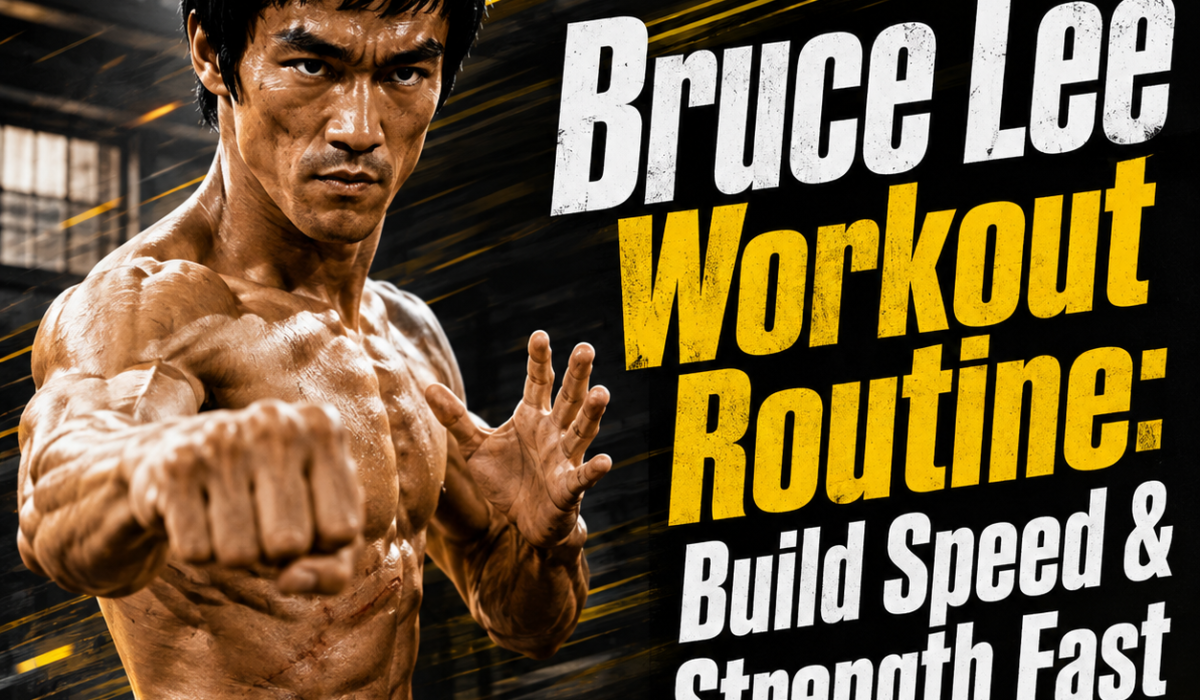
Bruce Lee is still one of the most searched names in fitness, martial arts, and bodyweight training for one simple reason: people want to know how he built a body that was fast, powerful, lean, and highly functional. The Bruce Lee workout routine was not about looking bulky. It was about maximizing speed, strength, endurance, flexibility, and explosive power in a small, efficient frame.
If your goal is to build athletic performance fast, Bruce Lee’s training style offers one of the best models ever developed. It combines strength training, calisthenics, cardio, mobility, martial arts practice, and intense focus on movement quality.
This article explains what Bruce Lee actually did, how his routine worked, and how you can use the same principles to build speed and strength quickly.
Table of Contents
- What Made Bruce Lee’s Workout Routine So Effective?
- Bruce Lee’s Training Philosophy
- The Main Components of the Bruce Lee Workout Routine
- Bruce Lee Workout Routine Sample
- A Bruce Lee-Inspired Workout Routine for Speed and Strength
- How Bruce Lee Built Speed
- How Bruce Lee Built Strength Without Getting Bulky
- Bruce Lee’s Favorite Training Principles
- Best Exercises Inspired by Bruce Lee
- What Bruce Lee Ate to Support His Training
- Common Mistakes When Copying the Bruce Lee Workout Routine
- Who Should Follow a Bruce Lee Style Workout?
- Who Should Be Careful?
- How Fast Can You See Results?
- Final Thoughts
What Made Bruce Lee’s Workout Routine So Effective?
Bruce Lee trained for performance, not just appearance. His routine was designed to help him:
- Punch faster
- Kick harder
- Move with explosive speed
- Stay lean and light
- Improve endurance
- Build functional strength
- Reduce injury risk
- Support martial arts skill development
Unlike many modern bodybuilding routines, the Bruce Lee workout routine focused on practical athletic ability. He wanted a body that could perform under pressure.
That is why his training combined:
- Strength work for power
- Calisthenics for body control
- Cardio for conditioning
- Flexibility training for range of motion
- Martial arts drills for skill and speed
- Core work for stability and force transfer
For readers who want to compare his style with other performance-focused methods, a useful related read is bodyweight workout training for full-body strength.
What made the Bruce Lee workout routine special was not just the exercises themselves, but the way they worked together. A fighter needs more than muscle. He needs timing, coordination, mobility, and the ability to repeat explosive efforts without fading. That is why Bruce Lee’s training still stands out decades later.
His approach was also adaptable. He changed methods when they stopped working, which helped him keep improving. That flexibility is one of the reasons the Bruce Lee workout routine remains relevant for athletes, fighters, and anyone who wants real-world fitness instead of vanity training.
Bruce Lee’s Training Philosophy
Bruce Lee believed in adapting training to the individual. He did not blindly follow one system forever. Instead, he used a principle often summarized as:
Absorb what is useful, discard what is useless, and add what is specifically your own.
In fitness terms, that means:
- Train movements that improve performance
- Avoid unnecessary volume
- Focus on quality over ego
- Keep the body lean and agile
- Develop all-around athleticism
His approach was ahead of its time because he understood that speed and strength come from more than just lifting heavy weights. They also come from movement efficiency, coordination, recovery, and consistency.
The Bruce Lee workout routine also shows why no single style of exercise should dominate every goal. Strength helps generate force, but so does technique. Conditioning supports repeatability, but so does recovery. Mobility lets you move freely, but only if you maintain it consistently. Bruce Lee built these qualities together instead of treating them as separate goals.
That mindset is useful for modern training too. If your workouts improve only one quality while neglecting the rest, your performance eventually stalls. The Bruce Lee workout routine avoids that trap by keeping the body balanced, responsive, and ready for action.
The Main Components of the Bruce Lee Workout Routine
To understand how Bruce Lee built speed and strength fast, it helps to break down his routine into key parts.
1. Strength Training
Bruce Lee used weight training to build explosive power and support his martial arts practice. He did not use bodybuilding-style training aimed at maximum muscle size. Instead, he focused on exercises that improved functional strength.
Common exercises included:
- Squats
- Deadlifts
- Bench press
- Clean and press
- Rows
- Curls
- Wrist and forearm work
He often trained with moderate weights and emphasized speed, form, and athletic transfer.
Strength training in the Bruce Lee workout routine was meant to support movement, not slow it down. That is an important distinction. The goal was to create usable power for striking, grappling, and fast transitions, not just to increase the number on the bar.
2. Calisthenics
Bodyweight exercises were a major part of his routine. These helped him build relative strength, muscular control, and endurance without adding unnecessary bulk.
Typical calisthenics included:
- Push-ups
- One-arm push-ups
- Pull-ups
- Chin-ups
- Sit-ups
- Leg raises
- Planks
These exercises helped Bruce Lee maintain a strong, lean physique that supported fast movement.
Calisthenics also made the Bruce Lee workout routine practical. You can train many of these movements with minimal equipment, which means you can keep progressing whether you are in a gym, at home, or traveling. If you want more ideas built around bodyweight strength, the bodyweight workout guide can help you build a similar foundation.
3. Martial Arts Practice
Bruce Lee spent a large amount of time on martial arts drills. This was not just skill practice; it was also conditioning.
Martial arts training included:
- Punch combinations
- Kicking drills
- Footwork
- Sparring
- Bag work
- Reaction training
- Shadowboxing
This type of training improved timing, speed, coordination, and explosive force.
The Bruce Lee workout routine worked so well because it connected physical development to actual performance. Every repetition had a purpose. Instead of training only to fatigue muscles, he trained to improve skill under pressure.
4. Cardio and Conditioning
Bruce Lee was highly conditioned. He understood that speed and power are useless if you gas out quickly. His conditioning likely included running, skipping rope, and high-intensity training.
Cardio benefits in his system included:
- Better recovery between rounds
- Improved work capacity
- Leaner body composition
- Higher endurance
Conditioning is one of the biggest reasons the Bruce Lee workout routine remains attractive to athletes. Fast movement requires repeated recovery. If your heart and lungs cannot keep up, your performance drops even if your technique is solid.
For a deeper look at how cardio improves functional performance, see the broader training ideas in this Harvard Health overview of exercise benefits.
5. Flexibility and Mobility
Bruce Lee was unusually flexible and mobile. That helped him kick high, move quickly, and avoid stiffness.
He used stretching and mobility work to:
- Improve range of motion
- Enhance kicking ability
- Prevent injury
- Support better movement mechanics
Mobility work is often ignored by people who try to copy the Bruce Lee workout routine. That is a mistake. Without mobility, speed and strength cannot be expressed well. Tight hips, stiff shoulders, and limited spinal rotation can reduce athletic power even if you are strong.
Bruce Lee treated flexibility as a performance tool. It was not an afterthought. It helped him maintain smooth mechanics, especially when moving fast or striking from unusual angles.
6. Core Training
Bruce Lee placed a strong emphasis on abdominal and trunk training. A strong core improves balance, striking power, and force transfer.
Core work may have included:
- Sit-ups
- Twists
- Hanging leg raises
- Static holds
- Isometric contractions
In the Bruce Lee workout routine, core training was not just about six-pack appearance. It helped connect the lower body and upper body so force could move efficiently through the whole system.
A stronger trunk can also help with posture, bracing, and quick changes of direction. Those qualities matter in martial arts and in general athletic training.
Bruce Lee Workout Routine Sample
Bruce Lee’s exact routine changed over time, but the following sample reflects the style and structure of his training.
Morning Training
A typical morning session may include:
- Light warm-up
- Stretching
- Martial arts skill work
- Bag work or shadowboxing
- Cardio conditioning
Midday or Afternoon Strength Session
This session could include:
- Squats
- Bench press
- Rows
- Deadlifts
- Curls
- Calf raises
- Wrist exercises
Evening Session
An evening session might focus on:
- Calisthenics
- Core work
- Flexibility
- Light technique practice
This kind of split allowed Bruce Lee to train multiple performance qualities without overloading one system too much at once.
A modern Bruce Lee workout routine does not need to copy this schedule exactly. The more important lesson is how he spread his training across the day to support performance, not just fatigue. If you train this way, you can keep the quality of each session higher.
A Bruce Lee-Inspired Workout Routine for Speed and Strength
If you want a modern version of the Bruce Lee workout routine, the goal is to train like an athlete, not a bodybuilder.
Here is a simple structure you can follow.
Day 1: Strength and Power
Warm-up
– Jump rope: 3–5 minutes
– Dynamic stretching: 5 minutes
Main lifts
– Squat: 4 sets of 5 reps
– Bench press: 4 sets of 5 reps
– Pull-ups: 4 sets to near failure
– Deadlift: 3 sets of 3 reps
Accessory work
– Hanging leg raises: 3 sets of 12
– Plank: 3 rounds of 45–60 seconds
– Forearm curls: 3 sets of 15
Day 2: Speed and Martial Arts Conditioning
Warm-up
– Light jogging or jump rope: 5 minutes
Skill work
– Shadowboxing: 5 rounds
– Heavy bag punches: 5 rounds
– Kicking drills: 5 rounds
– Footwork drills: 10 minutes
Conditioning
– Sprint intervals: 6–10 rounds
– Rest: 60–90 seconds between sprints
Core
– Sit-ups: 3 sets of 20
– Russian twists: 3 sets of 20
Day 3: Calisthenics and Mobility
Bodyweight circuit
– Push-ups: 4 sets of 20
– Chin-ups: 4 sets of 8–12
– Dips: 4 sets of 10–15
– Bodyweight squats: 4 sets of 25
– Leg raises: 3 sets of 15
Mobility
– Hamstring stretch
– Hip flexor stretch
– Shoulder mobility
– Spinal rotation work
Day 4: Active Recovery or Light Skill Work
– Walking
– Easy shadowboxing
– Stretching
– Mobility drills
– Breathing work
Repeat the cycle based on your schedule and recovery level.
Many athletes find that this kind of structure gives them the best of both worlds: heavy lifting for strength and fast, technical work for performance. The Bruce Lee workout routine is effective because it balances intensity with purpose. When you train too many hard sessions in a row, your speed drops. When you train too lightly, your body never adapts. This style helps you stay in the productive middle.
How Bruce Lee Built Speed
A common question is: How did Bruce Lee get so fast?
The answer was not one secret exercise. It was a combination of factors.
1. He Trained Explosively
Bruce Lee often used fast, controlled movement. This helped develop rate of force production, which is a major component of speed.
2. He Stayed Lean
Excess body fat slows movement and reduces relative power. Bruce Lee kept his body lean, which helped him move quickly and efficiently.
3. He Practiced Technique Repeatedly
Speed in martial arts comes from good mechanics. The more efficient the movement, the faster it becomes.
4. He Trained the Nervous System
Explosive drills, striking, and reaction work improved his nervous system’s ability to fire quickly.
5. He Was Highly Conditioned
Fatigue kills speed. Bruce Lee’s conditioning helped him stay fast longer.
The Bruce Lee workout routine also supported speed through repetition. Fast athletes usually spend a lot of time practicing movement patterns until they become automatic. That reduces hesitation, improves coordination, and helps every strike or step happen with less wasted motion.
How Bruce Lee Built Strength Without Getting Bulky
Another common question is whether Bruce Lee lifted weights.
Yes, he did. But his goal was strength with agility, not maximum size.
He built strength by using:
- Compound lifts
- Bodyweight training
- Isometric exercises
- Grip and forearm work
- Explosive movements
He likely avoided excessive training volume that would slow him down or add unnecessary mass.
If your goal is speed and strength fast, this is an important lesson: train hard, but don’t overtrain for size if performance is the priority.
The Bruce Lee workout routine shows that you do not need to be massive to be strong. Relative strength, which is strength compared with body weight, is often more useful in combat sports and athletic movement than pure size. That is why body control, coordination, and efficient lifting matter so much.
Bruce Lee’s Favorite Training Principles
The Bruce Lee workout routine was built on smart training principles that still work today.
Train the Whole Body
Instead of isolating muscles too much, he focused on integrated movement.
Prioritize Function
Every exercise should serve a purpose.
Use Progressive Overload
To get stronger, increase the challenge over time.
Stay Lean
Performance improves when the body is efficient.
Recover Properly
Training is only effective if recovery supports adaptation.
Train Mobility and Strength Together
A strong body that moves poorly is incomplete.
These ideas are simple, but they are powerful. If you follow the Bruce Lee workout routine mindset, you stop chasing random exercises and start asking whether each session improves real performance. That shift alone can make your training more effective.
Best Exercises Inspired by Bruce Lee
If you want to train like Bruce Lee, these exercises are especially useful.
For Speed
- Shadowboxing
- Sprint intervals
- Jump rope
- Plyometric push-ups
- Speed bag work
- Reaction drills
For Strength
- Squats
- Deadlifts
- Pull-ups
- Bench press
- Dips
- Rows
For Core Power
- Hanging leg raises
- Planks
- Russian twists
- Sit-ups
- Ab rollouts
For Flexibility
- Hip stretches
- Hamstring stretches
- Shoulder mobility drills
- Dynamic kicks
- Deep lunges
Many people use the Bruce Lee workout routine as a shortcut to get lean and powerful, but the best results come from combining these exercises in a balanced plan. Speed work, strength work, and mobility work all support each other.
What Bruce Lee Ate to Support His Training
Workout results are not just about training. Nutrition matters too. Bruce Lee reportedly favored a diet built around quality protein, vegetables, rice, fruit, and other whole foods.
A performance-focused diet should include:
- Lean protein
- Complex carbohydrates
- Healthy fats
- Plenty of water
- Enough calories to support training
- Limited junk food
For speed and strength, you want to be fueled but not sluggish.
The Bruce Lee workout routine works best when nutrition supports recovery and training output. Protein helps repair tissue, carbohydrates help replenish energy, and hydration supports performance. If you under-eat, your energy drops. If you overeat heavily processed foods, your recovery and mobility can suffer. The best approach is simple and consistent.
Common Mistakes When Copying the Bruce Lee Workout Routine
Many people try to imitate Bruce Lee training but make avoidable mistakes.
1. Training Too Much
More is not always better. Bruce Lee trained often, but purposefully.
2. Ignoring Recovery
Sleep and rest are essential for strength and speed gains.
3. Focusing Only on Lifting
Weights matter, but so do mobility, cardio, and skill.
4. Not Staying Lean
Speed drops when body composition gets out of control.
5. Skipping Technique Work
Raw strength is less useful without good movement.
6. Using Poor Form
Speed and force depend on efficient mechanics.
Another mistake is chasing the Bruce Lee workout routine as if it were a fixed checklist. Bruce Lee himself did not think that way. He adjusted training based on what worked. That is the real lesson: use the model, but tailor the plan to your body, schedule, and goals.
Who Should Follow a Bruce Lee Style Workout?
This kind of training is ideal for people who want:
- Better athletic performance
- Faster movement
- Functional strength
- A lean, defined physique
- Better conditioning
- Martial arts support
- More mobility and body control
It is especially useful for athletes, fighters, and anyone who wants to be strong without becoming slow.
The Bruce Lee workout routine is also helpful for general fitness enthusiasts who are tired of one-dimensional programs. If you want to move better in daily life, maintain energy, and build a body that feels capable, this style of training is a strong fit.
Who Should Be Careful?
If you are new to exercise, have injuries, or are returning after a long break, start gradually. The Bruce Lee workout routine can be intense. You do not need to copy his exact volume to get results.
Begin with:
- Basic bodyweight exercises
- Light strength training
- Short cardio sessions
- Daily mobility work
Then increase intensity over time.
Anyone with a medical condition or persistent pain should also get guidance from a qualified professional before following a more demanding plan. The Bruce Lee workout routine is performance-focused, but smart training still comes first.
How Fast Can You See Results?
If you train consistently, eat well, and recover properly, you may notice improvements in:
- Energy
- Conditioning
- Speed
- Strength
- Core stability
- Mobility
within a few weeks. Larger changes in performance and body composition usually take several months.
The key is consistency. Bruce Lee did not build his capabilities overnight. He developed them through disciplined, repeated training.
It also helps to track progress. Note your sprint times, pull-up numbers, lifting performance, and mobility improvements. That way you can see whether your version of the Bruce Lee workout routine is truly making you faster, stronger, and more capable over time.
Final Thoughts
The Bruce Lee workout routine is powerful because it is based on performance, not hype. It combines strength, speed, conditioning, mobility, and skill in a way that creates a lean, explosive, highly capable body.
If your goal is to build speed and strength fast, the best lesson from Bruce Lee is simple: train with purpose. Use compound lifts, bodyweight exercises, explosive drills, martial arts movement, and mobility work. Stay lean, recover well, and focus on improving function every session.
That is how Bruce Lee trained for real-world athletic ability—and that is why his approach still works today.