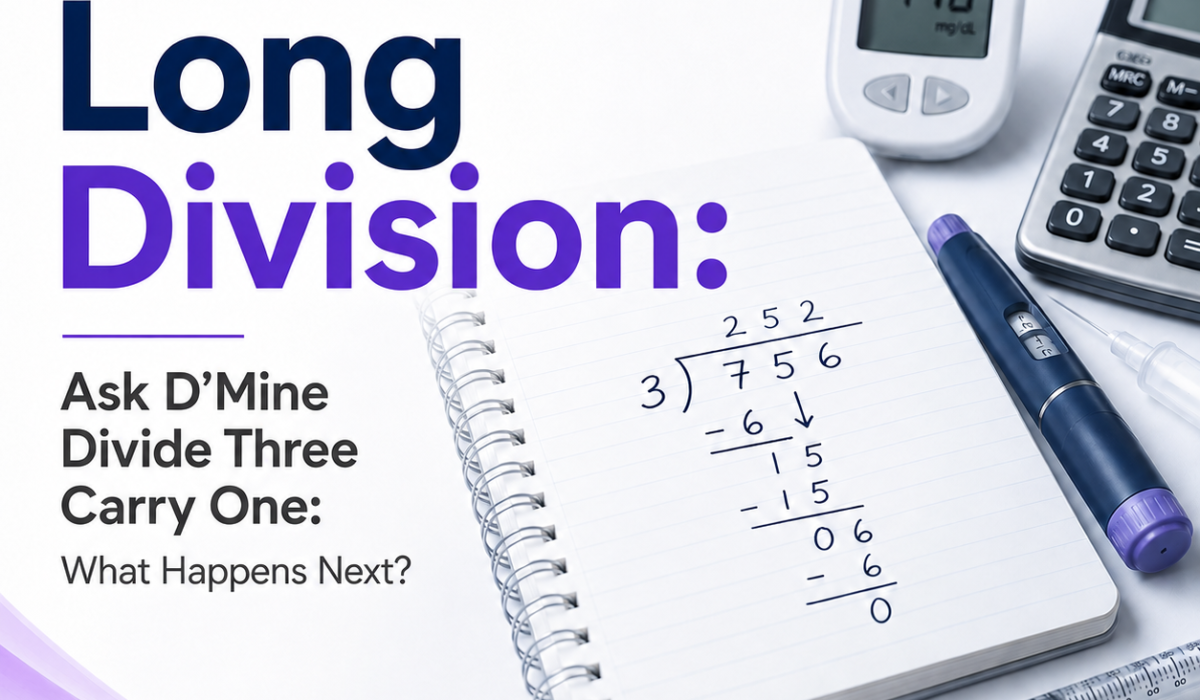
If you’re searching for “Ask Dmine Divide Three Carry One: What Happens Next?”, you’re likely trying to understand a math step or a phrase used in a puzzle, worksheet, or educational prompt. The short answer is this: you need to interpret the operation in context and then perform the next arithmetic step based on division, regrouping, or long division rules.
Because the phrase is not a standard mathematical expression on its own, the most important thing is to break it down carefully. In many cases, readers are really asking how the next step works in long division, especially when a remainder appears and must be handled before moving on. If you want a broader refresher on division basics, this clear division guide from Math Is Fun is a helpful starting point.
What “Divide Three Carry One” Usually Means
In math, divide by three means split a number into three equal parts. The phrase “carry one” often appears in long division, multi-step arithmetic, or sometimes place-value regrouping.
So when someone says “divide three carry one,” they may be referring to one of these situations:
- Long division where a digit is divided by 3 and a remainder is carried to the next step
- Regrouping in arithmetic where 1 is added to the next place value
- A puzzle or instructional shorthand describing the next calculation step
This is also why the exact wording matters. The phrase can point to a division rule, a remainder, or a place-value move, and the correct answer depends on which one the writer intended. For a clear reference on division terminology, you can review the Math is Fun long division guide.
When a problem uses the phrase long division, the most useful habit is to slow down and identify the dividend, divisor, and any remainder before deciding the next move. In other words, the phrase is a clue, not a final answer, and the next step depends on the structure of the whole problem.
It also helps to remember that “carry one” is not always literal. In some classroom language, it may refer to regrouping, while in others it may describe what happens after a remainder is left over. That is why the same wording can show up in different kinds of math practice.
What Happens Next?
What happens next depends on the exact number or equation you are working with. Here’s the general process:
1. Divide the first part by 3
Take the first digit or group of digits and divide it by 3.
Example:
– 9 ÷ 3 = 3
– 10 ÷ 3 = 3 remainder 1
– 14 ÷ 3 = 4 remainder 2
If the number does not divide evenly, the remainder becomes important. In many classroom methods, that remainder is the clue that tells you whether to continue with another digit, write a remainder, or convert the result into a decimal.
2. Carry the remainder if needed
If the division does not come out evenly, the remainder is carried into the next step depending on the method being used.
For example, in long division:
– Divide 10 by 3
– The quotient is 3
– The remainder is 1
– That remainder may be combined with the next digit
This is the heart of many long division problems. The “carry one” idea usually means the remainder is not ignored; instead, it is passed along so the next digit can be processed correctly. That is why the phrase often appears in instructions for multi-digit division or regrouping. In a workbook setting, the next step usually depends on whether the problem wants a whole-number quotient, a decimal answer, or a remainder written at the end.
3. Continue to the next digit or step
After carrying, you proceed with the next calculation.
Example:
If you are dividing a larger number, you would:
– Divide the next value
– Add any carried amount if required
– Continue until the full expression is solved
When a student is learning long division, this pattern becomes familiar quickly: divide, multiply, subtract, bring down, and repeat. Once that sequence is understood, the phrase becomes much less mysterious. The same routine appears again and again, so learning it once makes many later problems easier.
Another helpful way to think about it is this: the quotient tells you how many equal groups fit, while the remainder tells you what is left over. After that, the next step is simply the correct follow-up action for that leftover amount.
Simple Example of “Divide Three Carry One”
Let’s say the problem is something like 13 ÷ 3.
1. 3 goes into 13 four times because:
– 3 × 4 = 12
2. That leaves a remainder of 1
3. That remainder is the “carry one” in some contexts
4. The next step depends on whether you are continuing a longer division problem or converting to a decimal
So after “divide by three, carry one,” the next step is usually:
– use the carried remainder in the next place value, or
– write the remainder and continue, depending on the method
In a longer problem, the remainder is only part of the answer. The full solution often includes another digit, another quotient step, or a new place value. That is why the phrase is more of a direction than a complete calculation.
For example, if the task is written as a division exercise, you may need to continue by bringing down the next digit. If the task is a regrouping exercise, you may instead move the leftover value to the next column. Either way, the phrase points to a transition, not a finish line.
That transition is exactly where many learners pause. They know how to divide by 3, but they are unsure what to do with the remainder. The answer is to check the instructions carefully and follow the form of the exercise.
If This Is Long Division
In long division, “what happens next” is usually this sequence:
- Divide
- Multiply
- Subtract
- Bring down the next digit
- Repeat
For example, in 157 ÷ 3:
– 3 goes into 15 five times
– 5 × 3 = 15
– Subtract: 15 − 15 = 0
– Bring down 7
– 3 goes into 7 two times
– 2 × 3 = 6
– Subtract: 7 − 6 = 1
The final answer is 52 remainder 1.
That remainder 1 is sometimes the “carry one” people refer to. If the problem continues, that remainder may be turned into a decimal or used in the next step of a larger equation. In many worksheets, this is exactly where students pause and ask what comes next in long division.
To see the standard process in another educational resource, the Khan Academy long division introduction offers a helpful walkthrough of the same idea.
When the quotient is not exact, the next step may be to add a decimal point and continue the division. That keeps the process consistent and gives a more precise answer. If the worksheet allows remainders, though, you can stop once the remainder is clearly shown.
In practice, the long division method is just a repeating cycle. Once you divide one part, the only question is whether you need to repeat the cycle with the next digit or stop and record what remains. That decision is what the phrase is really asking you to make.
If This Is a Regrouping Problem
Sometimes “carry one” is used in addition or multiplication, not division.
Example:
– 27 + 15 = 42
– 7 + 5 = 12
– Write 2, carry 1
Here, the “carry one” means you move 1 ten to the next column.
If your phrase came from a worksheet or school instruction, it may be describing a place-value adjustment rather than a pure division problem. That distinction matters because the next action is different: in addition, the carry goes to the next column; in division, the remainder may be brought down, written as part of the answer, or converted depending on the task.
When students are first learning number sense, this is one of the easiest places to get confused. A single word like “carry” can mean something slightly different depending on whether the operation is addition, multiplication, or long division.
If the exercise is regrouping, the “next” step usually means adding the carried value to the next column and continuing the calculation. If the exercise is division, the next step is usually to interpret the remainder correctly. The key is to match the operation to the method.
Why the Phrase Can Be Confusing
The phrase “Ask Dmine Divide Three Carry One” is not standard textbook wording. It may be:
- a misheard instruction
- an OCR or transcription error
- shorthand from a teacher or puzzle
- part of a larger math expression
That’s why the best way to answer “what happens next?” is to identify the exact operation and follow the rules for that operation. If the worksheet is about division, then the next step is likely a quotient step, a remainder, or a bring-down step. If it is about regrouping, then the next step is a place-value shift.
In practical terms, the phrase should be treated as a clue, not a final formula. The wording tells you to pay attention to the number, the operation, and the direction of movement from one step to the next. That is the most reliable way to solve the problem without guessing. It also explains why the same wording can feel clear to one student and confusing to another: one may recognize the context immediately, while the other may only see an incomplete sentence.
A useful strategy is to rewrite the problem in standard math language. For example, turn “divide three carry one” into “divide by 3 and carry the remainder” or “divide by 3 and regroup the leftover amount.” Once rewritten, the next step usually becomes obvious.
Quick Rules to Remember
If the problem says divide by 3:
- Find how many groups of 3 fit into the number
- Write the quotient
- Handle any remainder
If the problem says carry one:
- Add 1 to the next place value
- Continue with the next column or digit
If the problem involves both:
- Divide first
- Then carry or regroup as instructed
- Move to the next step
These rules are simple, but they cover most versions of the problem. Once you know whether the number is being divided, regrouped, or both, the next action becomes straightforward instead of confusing.
A good habit is to write each step clearly on paper. Mark the quotient, circle the remainder if needed, and show any carried value in the correct column. This makes it easier to follow the logic of the problem and avoids small mistakes that can change the answer.
It also helps to check whether the result should be written as a whole number, a mixed answer with a remainder, or a decimal. That detail often tells you exactly how far to continue. In many school problems, the instructions decide the endpoint more than the arithmetic itself does.
Worked Example With a Larger Number
Let’s walk through a slightly larger example to show how the logic works in practice. Suppose you have 245 ÷ 3.
First, divide 24 by 3. Since 3 goes into 24 eight times, write 8 above the 4 in the quotient. Then multiply 8 × 3 = 24 and subtract, leaving 0. Bring down the 5. Now divide 5 by 3. Three goes into 5 once, so write 1 in the quotient. Multiply 1 × 3 = 3, subtract, and you get a remainder of 2.
The result is 81 remainder 2.
This example shows the same pattern people often mean when they say long division with a carry or remainder. The divide-three step happens first, and then the next digit is handled with whatever remainder is left. If the problem asks for a decimal, you would continue by adding zeros and dividing further. If it asks for a remainder, you stop there.
Now notice what the example teaches: the first division step is easy, but the answer is not complete until the remainder is understood. That is the real “what happens next” in many math problems that mention carrying. The process only ends when the instruction says to stop.
If you are teaching or studying this concept, it can be helpful to practice on numbers that divide evenly first, then move to problems with leftovers. That builds confidence before you have to interpret a remainder in a more advanced problem.
How to Tell Whether You Should Carry or Stop
Not every division problem uses the same ending. Here are the most common cases:
- Whole number answer only: stop when the remainder is written
- Decimal answer: add a decimal point and continue dividing
- Fraction answer: write the remainder over the divisor
- Regrouping problem: move the carried value into the next column
So if a prompt says “divide three carry one,” your next move depends on what the exercise asks for. A teacher may expect a remainder, a decimal, or a continued chain of steps. The math does not change; only the format of the final answer does.
When in doubt, look for clues in the wording. Words like “round,” “estimate,” or “remain” suggest a different outcome than “write the answer as a decimal.” Those small details determine whether you stop early or keep going. This is especially important in long division, where the final line of a solution can look different depending on the assignment.
Common Mistakes to Avoid
There are a few mistakes that show up again and again in this kind of problem:
- Forgetting to subtract after multiplying in long division
- Ignoring the remainder when the problem expects it to be carried
- Mixing up carrying in addition with carrying in division
- Stopping too early before checking the next digit
- Assuming the phrase is a standard formula when it may be shorthand
If you slow down and follow the steps in order, the solution becomes much easier. In fact, many students find that once they understand the meaning of the carry, the rest of long division starts to feel repetitive in a helpful way. Repetition is a strength here because the process follows the same pattern every time.
Another common mistake is writing the remainder too soon. In a multi-digit problem, the remainder from one step may need to be combined with the next digit before the work is finished. That is why checking each stage matters. The small details are what turn a rough attempt into a correct answer.
It can also help to pause after each subtraction and ask, “Can I bring down another digit?” If the answer is yes, then the division is not finished yet. If the answer is no, then the remainder or decimal is your ending point.
When You Should Recheck the Work
Recheck your work any time the quotient looks too large, too small, or too neat to be true. Division by 3 often produces remainders, so an exact answer is not always expected. If you get a clean number and the original problem does not seem to divide evenly, it is worth going back over the subtraction step.
You should also recheck when the phrase appears in a puzzle or worksheet with unusual wording. The wording may hide a larger instruction, and the first interpretation may not be the right one. A quick rewrite of the problem in standard mathematical language often reveals the correct next step.
For students, rechecking is not a sign of weakness. It is part of the process. The more familiar you become with the structure of long division, the faster you will notice when a step has been skipped or when a remainder has been handled incorrectly.
Common Questions
What does “carry one” mean in math?
It means transferring 1 unit to the next place value when a number is too large for one digit.
What does “divide three” mean?
It means divide a number by 3, or split it into 3 equal parts.
What happens after dividing by 3 with a remainder?
You either keep the remainder, convert it into a decimal, or carry it forward depending on the problem.
Is “Ask Dmine Divide Three Carry One” a real math formula?
No, not as written. It sounds more like an instruction or phrase that needs context.
If you want to practice more on your own, it can help to compare the phrase with a formal division example in a classroom math book or a trusted learning site. Looking at a standard example side by side with the phrase makes it easier to see whether you are dealing with division, regrouping, or both. The more examples you study, the easier it becomes to spot the pattern quickly.
Another question students often ask is whether they should always write the remainder. The answer depends on the assignment. Some problems want the remainder shown, while others want you to continue until the decimal is complete. That detail is small, but it changes the final answer format.
Final Answer
If you are asking “Ask Dmine Divide Three Carry One: What Happens Next?”, the next step is usually to complete the division by 3, then carry or regroup any remainder or extra value according to the method being used. In most cases, you would divide, record the quotient, and then continue with the next digit or place value.
The exact answer depends on the full problem, but the general rule is simple: divide first, then carry one if the calculation requires regrouping, and continue to the next step. When the expression is part of long division, the next move is usually to bring down the next digit and keep going until the problem is complete.
Once you recognize the pattern, the phrase is less confusing. It is not a special formula; it is a reminder to follow the next arithmetic step carefully and in order. Whether you are handling a remainder, a regrouped value, or a continuation in long division, the logic is the same: identify the step, apply the rule, and then move forward.
That simple process is the key to solving many classroom math questions that sound mysterious at first. When you treat the phrase as a step-by-step instruction instead of a strange code, the answer becomes much easier to see.