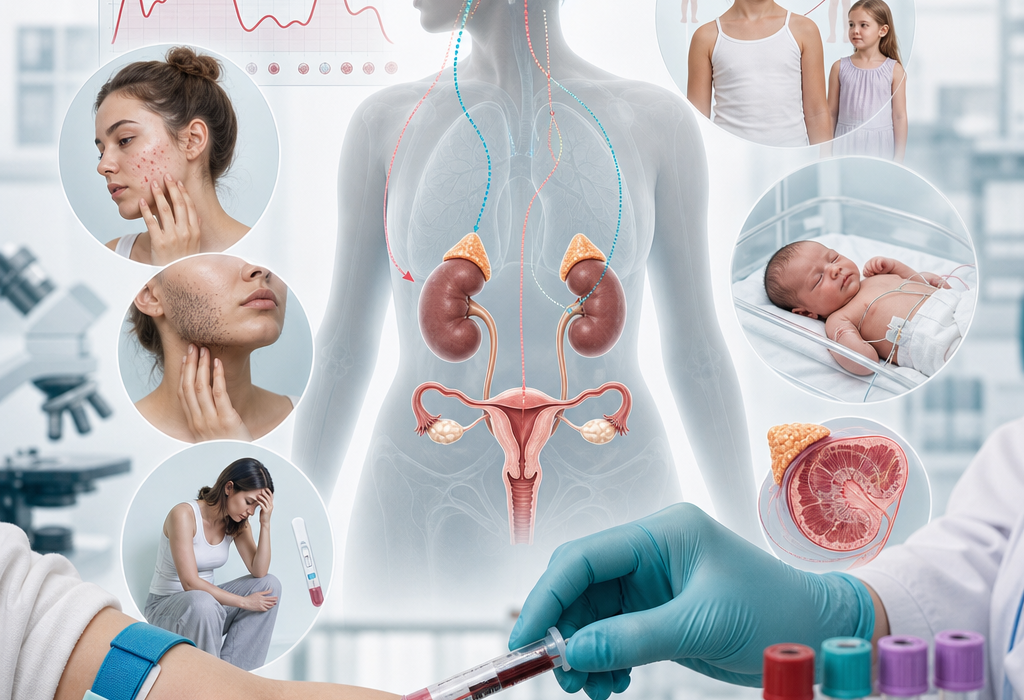
The 17 hydroxyprogesterone test is a blood test doctors use to look for hormone imbalances that may affect periods, fertility, puberty, or newborn health. 17 OH progesterone, also written as 17-hydroxyprogesterone (17-OHP), is a hormone made by the adrenal glands and ovaries. It plays an important role in hormone production, including the pathway that leads to cortisol and, in some cases, excess androgen production.
A 17 hydroxyprogesterone test is commonly used to help evaluate congenital adrenal hyperplasia (CAH), especially the more common 21-hydroxylase deficiency form. It may also be ordered when someone has symptoms such as irregular periods, excess hair growth, acne, infertility, or signs of early puberty.
This article explains what 17 OH progesterone means, why it matters, what symptoms may point to a problem, how the test is done, and how to understand results.
Table of Contents
- What is 17 OH progesterone?
- Why is 17 OH progesterone important?
- Symptoms of high 17 OH progesterone
- What is the 17 OH progesterone test?
- What do 17 OH progesterone test results mean?
- Common questions about 17 OH progesterone
- What happens after an abnormal test?
- How is congenital adrenal hyperplasia treated?
- When should you talk to a doctor?
- Key takeaways
What is 17 OH progesterone?
17 OH progesterone is a steroid hormone intermediate. That means it is part of a chain of hormone production rather than the final hormone itself.
Your body uses it to make other hormones, including:
- Cortisol, which helps the body respond to stress and regulate metabolism
- Androgens, which are sex hormones such as testosterone
- In some pathways, aldosterone, which helps control salt and fluid balance
Because 17 OH progesterone sits in the middle of this hormone pathway, abnormal levels can suggest that a certain enzyme is not working properly.
In a healthy pathway, the adrenal glands convert hormone precursors efficiently. When that process is disrupted, the body may divert more material toward androgen production. That is one reason the 17 hydroxyprogesterone test can be so useful when symptoms suggest an adrenal or reproductive hormone disorder.
For a general overview of related adrenal hormone conditions, the MedlinePlus hormone health resources provide reliable, patient-friendly background information.
Why is 17 OH progesterone important?
The most common reason clinicians measure 17 OH progesterone is to check for congenital adrenal hyperplasia (CAH). CAH is a group of inherited conditions that affect how the adrenal glands make hormones.
In 21-hydroxylase deficiency, the body cannot efficiently convert 17 OH progesterone into cortisol. As a result:
- 17 OH progesterone builds up
- Cortisol levels may drop
- The body may make more androgens
This hormone imbalance can cause symptoms that vary depending on age, sex, and whether the condition is mild or severe.
The 17 hydroxyprogesterone test is especially important because some people with CAH do not have obvious symptoms right away. Others may have signs that are mistaken for common issues such as acne, irregular cycles, or early puberty. In newborns, however, the test can help identify a potentially urgent problem before serious complications develop.
When doctors suspect a hormone disorder, the 17 hydroxyprogesterone test is often one of the first labs they use to narrow the possibilities.
Symptoms of high 17 OH progesterone
High 17 OH progesterone itself is not always what causes symptoms. Rather, it often signals an underlying hormone disorder, especially CAH. Symptoms may appear differently in babies, children, teens, and adults.
Some people first hear about the 17 hydroxyprogesterone test only after a symptom pattern raises concern for excess adrenal hormone production.
In newborns and infants
Severe forms of CAH can be serious and sometimes life-threatening. Possible symptoms include:
- Poor feeding
- Vomiting
- Dehydration
- Weight loss
- Low energy
- Salt loss
- Shock in severe cases
In some babies with CAH, genital development may look atypical. This is more noticeable in genetic females, but the appearance can vary.
Because of these risks, a doctor may order a 17 hydroxyprogesterone test promptly after an abnormal newborn screen or when symptoms raise concern for adrenal insufficiency.
In children
Children with elevated androgen levels from CAH may have:
- Early pubic or underarm hair
- Rapid growth at first
- Advanced bone age
- Early puberty signs
- Acne
- Body odor earlier than expected
Although a child may grow quickly at first, untreated hormone imbalance can eventually lead to shorter adult height because bones mature too fast.
When these signs appear, clinicians often combine the 17 hydroxyprogesterone test with other blood work and growth checks to better understand what is happening.
In adolescents and adults
In teens and adults, high 17 OH progesterone may be associated with:
- Irregular menstrual periods
- Missed periods
- Infertility
- Excess facial or body hair
- Acne
- Thinning scalp hair
- Deepening of the voice in severe androgen excess
- Low libido in some cases
Some people with milder forms of CAH may not realize they have a hormone disorder until testing is done for infertility or menstrual irregularity. In those situations, a 17 hydroxyprogesterone test may uncover a pattern that explains years of unexplained symptoms.
If you are comparing hormone-related symptoms with a separate reproductive issue, you may also find this internal resource helpful: 14 DPO: What It Means and What to Expect.
Symptoms of low 17 OH progesterone
Low 17 OH progesterone is usually less of a concern by itself. It may simply reflect normal hormone patterns, medication effects, or differences in timing of the blood draw.
However, low values can sometimes be seen if:
- The adrenal glands are not making enough hormones
- Certain hormone-suppressing medications are being used
- The sample was taken at a time when levels are naturally lower
A low result is usually interpreted in the context of the person’s symptoms and other lab tests.
When a low result is unexpected, a clinician may decide whether repeat testing is needed. The 17 hydroxyprogesterone test is most useful when it is interpreted alongside the whole clinical picture, not in isolation.
What is the 17 OH progesterone test?
The 17 OH progesterone blood test measures the amount of this hormone in the blood. It is often used to help diagnose or rule out CAH.
The test may be ordered for:
- Newborn screening follow-up
- Irregular periods
- Infertility
- Excess hair growth
- Severe acne
- Virilization symptoms
- Suspected adrenal disorders
- Early puberty
- Evaluation of abnormal hormone levels
In many cases, the test is part of a larger hormonal workup rather than a stand-alone diagnosis.
The 17 hydroxyprogesterone test is often chosen because it is practical, widely available, and able to point clinicians toward the next most useful step. When results are borderline, follow-up testing can clarify whether the problem is temporary, inherited, or related to another endocrine condition.
How to prepare for the 17 hydroxyprogesterone test
Most people do not need complex preparation, but doctors may give specific instructions based on why the test is being ordered. Morning testing is often preferred because hormone levels can change during the day. If you menstruate, your clinician may also recommend a specific cycle day so the 17 hydroxyprogesterone test is easier to interpret.
Tell your doctor about any medications, including steroids, birth control, fertility treatments, or hormone therapies. These can affect results and may change how the test is timed or interpreted.
How the test is done
The test is usually a simple blood draw. A healthcare professional takes a blood sample from a vein, and it is sent to a lab for analysis.
Timing matters
For some people, especially those being evaluated for mild CAH, the time of day can affect results because hormone levels may naturally vary. Morning testing is often preferred.
Menstrual cycle matters
In people who menstruate, the phase of the cycle may also influence the result. Doctors may choose a specific time in the cycle depending on why the test is being done.
Additional testing
If the initial result is abnormal or borderline, a doctor may order:
- ACTH stimulation test
- Cortisol levels
- Androgen levels
- Electrolytes
- Renin and aldosterone
- Genetic testing in some cases
These follow-up tests help show whether the adrenal glands are responding normally. In some cases, they also help distinguish CAH from other causes of androgen excess. The 17 hydroxyprogesterone test is often just the starting point.
What do 17 OH progesterone test results mean?
Interpreting results depends on age, sex, lab method, and the reason for testing. What is considered normal can vary by laboratory.
Results from the 17 hydroxyprogesterone test are always read in context, because a single number does not tell the whole story.
Normal or expected result
A result in the normal range usually means there is no strong evidence of classic CAH. However, normal results do not always rule out all hormone disorders, especially if symptoms remain significant.
Mildly elevated result
A mildly high 17 OH progesterone level can suggest:
- Nonclassic congenital adrenal hyperplasia
- Stress on the adrenal glands
- Timing effects from the menstrual cycle
- Rarely, other adrenal or ovarian hormone disorders
This is one reason doctors may repeat the test or order a stimulation test before making a diagnosis.
If your result is only slightly high, the 17 hydroxyprogesterone test may need follow-up before anyone can say whether it reflects a true hormone disorder.
Very high result
A very high level raises stronger concern for CAH, especially 21-hydroxylase deficiency. In infants, this may require prompt evaluation because some forms can affect salt balance and hydration.
If you are trying to understand why symptoms and test results do not always match, remember that lab timing, age, and menstrual phase can all influence the final interpretation of the 17 hydroxyprogesterone test.
How doctors interpret the 17 hydroxyprogesterone test
Doctors rarely make decisions based on this result alone. Instead, they look at the pattern of symptoms, physical findings, and other hormone results. For example, a person with acne and irregular cycles may need different follow-up than a newborn with vomiting and dehydration. The same 17 hydroxyprogesterone test can mean something very different depending on age and clinical context.
That broader approach helps separate temporary hormone shifts from inherited adrenal disorders. It also helps identify people who may benefit from repeat testing, an ACTH stimulation test, or referral to an endocrinologist.
Common questions about 17 OH progesterone
Is 17 OH progesterone the same as progesterone?
No. They are related but not the same.
- Progesterone is a hormone involved in the menstrual cycle and pregnancy
- 17 OH progesterone is a hormone precursor in adrenal hormone production
They have different roles and are measured for different reasons.
What causes high 17 OH progesterone?
Common causes include:
- Congenital adrenal hyperplasia
- Adrenal gland overproduction
- Ovarian hormone disorders
- Stress or illness affecting the adrenal glands
- Lab timing differences
The most important cause to rule out is CAH.
In everyday practice, the 17 hydroxyprogesterone test is often ordered because high levels are a clue, not a diagnosis by themselves. That is why the result should be reviewed alongside symptoms and follow-up testing.
Can 17 OH progesterone affect fertility?
Yes. If high 17 OH progesterone is part of an underlying hormone imbalance, it can interfere with ovulation and menstrual regularity, which may reduce fertility. Treating the underlying condition can often improve cycle regularity and conception chances.
Can it cause acne or hair growth?
Yes. When high 17 OH progesterone is linked to increased androgen production, it may contribute to:
- Acne
- Hirsutism, or excess facial/body hair
- Thinning scalp hair
- Irregular periods
In people with these symptoms, the 17 hydroxyprogesterone test may help point toward an adrenal cause rather than a skin-only or cycle-only issue.
Is a high result always serious?
Not always. A mildly elevated result may be due to the menstrual cycle, stress, or a nonclassic form of CAH. But a higher result should be reviewed by a healthcare professional because it may indicate a condition that needs treatment.
For readers who want to compare hormone testing with another common medical workup, this related article may be useful: Combined Infusion Set and CGM Sensor: Easy Diabetes Tech.
What happens after an abnormal test?
If your 17 OH progesterone result is abnormal, the next step depends on how high it is and what symptoms you have.
A doctor may:
- Repeat the test
- Order an ACTH stimulation test
- Check other hormone levels
- Evaluate menstrual history, puberty, fertility, or adrenal symptoms
- Refer to an endocrinologist
The goal is to determine whether the result reflects a true hormone disorder or a temporary variation.
Sometimes a single 17 hydroxyprogesterone test result does not settle the question. If the level is borderline, repeating the lab at the correct time of day or in a specific part of the menstrual cycle can be the simplest way to avoid a misleading result.
How is congenital adrenal hyperplasia treated?
If high 17 OH progesterone is caused by CAH, treatment depends on the type and severity of the condition.
Possible treatment options include:
- Glucocorticoid medications to replace cortisol or reduce excess hormone production
- Mineralocorticoid therapy in salt-wasting forms
- Monitoring growth and puberty in children
- Hormonal management for menstrual irregularity or androgen excess
- Fertility treatment in some adults
Treatment is individualized and usually managed by an endocrinologist.
People diagnosed after an abnormal 17 hydroxyprogesterone test may need long-term follow-up. That follow-up often focuses on symptom control, hormone balance, and preventing complications from untreated adrenal dysfunction.
Living with a diagnosis after the 17 hydroxyprogesterone test
If the 17 hydroxyprogesterone test leads to a diagnosis of CAH or another hormone disorder, ongoing care may involve routine checkups, medication adjustments, and monitoring during times of stress, illness, pregnancy, or growth changes. Some people only need periodic follow-up, while others need more structured care.
Emotional support can also matter. Symptoms such as acne, body hair changes, infertility, or early puberty can be stressful, and a clear explanation of the diagnosis often helps people feel more in control of the next steps.
Keeping a record of symptoms, cycles, medications, and any new concerns can make future visits more productive and may help your clinician interpret the 17 hydroxyprogesterone test alongside the rest of your health history.
When should you talk to a doctor?
You should speak with a healthcare professional if you have:
- Irregular or missed periods
- Trouble getting pregnant
- Excess facial or body hair
- Severe acne
- Early puberty signs in a child
- A newborn with poor feeding, vomiting, dehydration, or unusual genital development
- A family history of CAH
Prompt evaluation is especially important in infants, because some adrenal disorders can become urgent quickly.
If you are already scheduled for a 17 hydroxyprogesterone test, bring a list of symptoms, medications, and any family history to your appointment. Those details can help the clinician interpret the result more accurately.
Key takeaways
17 OH progesterone is a hormone involved in adrenal and reproductive hormone production. It is most often tested to evaluate congenital adrenal hyperplasia, especially 21-hydroxylase deficiency.
A high 17 OH progesterone level may be linked to symptoms such as:
- Irregular periods
- Infertility
- Acne
- Excess hair growth
- Early puberty
- Signs of adrenal dysfunction in babies and children
The test is done with a blood sample, and results must be interpreted carefully based on age, timing, symptoms, and other hormone tests.
If your result is abnormal, it does not automatically mean you have a serious condition, but it does mean follow-up is important. A healthcare professional can help determine whether the result is normal variation, a mild form of CAH, or another hormone disorder.
When understood in context, the 17 hydroxyprogesterone test can be a valuable clue in finding the reason behind hormone-related symptoms and deciding on the next best step in care.